

Whether you play roulette at a live casino in Genting Highlands or on your phone through a Malaysian online platform, having a clear plan for how you bet makes a real difference to how long your bankroll lasts and how much you enjoy the session. This guide brings together every major roulette strategy -- Martingale, Fibonacci, D'Alembert, Labouchere, Paroli, Andrucci and more -- plus ten practical tips that apply to any system. Read it once and you will have all the knowledge you need to sit down at the wheel with confidence.
Understanding Roulette Basics
Since its invention in 17th-century France, the roulette game has captivated players around the world. The concept is straightforward: a dealer spins a numbered wheel in one direction and releases a small ball in the other. Players bet on where the ball will land.
The Roulette Wheel and Table
A standard European roulette wheel contains 37 pockets numbered 0 to 36, alternating between red and black with a single green zero. American roulette adds a second green pocket (00), raising the total to 38. The betting table beside the wheel is where you place chips -- on individual numbers, groups of numbers, or broader categories like red/black, odd/even, and high/low.
Types of Bets
Roulette offers a wide range of betting options. Inside bets cover specific numbers or small clusters and pay more but hit less often. Outside bets cover larger sections of the layout -- red/black, odd/even, dozens, columns -- and win more frequently but pay less. Knowing the difference is essential before applying any strategy, because most systems are designed around even-money outside bets.
European vs American Roulette
The single most important decision you can make is choosing European roulette over American roulette whenever possible. European roulette has a house edge of 2.70%, while the extra double-zero pocket in American roulette pushes the house edge to 5.26%. That difference directly affects how long your bankroll lasts and how effective any strategy can be. For Malaysian players, most online casinos offer both variants -- always pick the one with a single zero.
Top 10 Roulette Tips for Players
Before diving into specific betting systems, these ten practical tips will serve you well regardless of which strategy you adopt.
Tip 1: Learn the Rules Before You Play
Spend time understanding the game's mechanics, bet types, and payout ratios. The more familiar you are with how roulette bets work, the more confident and precise your decisions at the table will be. Knowledge removes guesswork.
Tip 2: Choose European Roulette
As covered above, European roulette has a house edge of 2.70% compared to 5.26% for American roulette. That single zero makes a measurable difference over dozens of spins. If a casino offers French roulette with the "La Partage" rule, even better -- your effective edge on even-money bets drops to roughly 1.35%.
Tip 3: Understand Betting Strategies
No strategy guarantees wins, but having a structured plan helps you manage bets and avoid impulsive decisions. Read the strategy breakdowns later in this guide and pick one that matches your risk tolerance and bankroll.
Tip 4: Set and Manage Your Bankroll
Decide how much you can afford to lose before you sit down, then divide that amount into session budgets. Never chase losses by dipping into money earmarked for rent, bills, or savings. Bankroll discipline is the single most important habit a roulette player can develop.
Tip 5: Start with Outside Bets
Outside bets like red/black, odd/even, and high/low pay 1:1 and win close to half the time. They keep your bankroll stable and give you a longer session. Inside bets on single numbers pay 35:1 but hit roughly once every 37 spins -- thrilling when they land, punishing when they don't.
Tip 6: Practice with Free Games First
Most Malaysian online casinos offer demo or free-play roulette. Use these to test strategies, get comfortable with the interface, and build confidence before wagering real money. There is no substitute for hands-on practice.
Tip 7: Ignore "Guaranteed Win" Systems
If someone claims a system beats roulette every time, walk away. The house edge is a mathematical fact. Strategies manage risk and structure your play -- they do not eliminate randomness. Be realistic about what any system can achieve.
Tip 8: Know When to Walk Away
Set a win target and a loss limit for every session. If you hit either, stop. Continuing to play after a big win often leads to giving it all back; continuing after a big loss often leads to reckless bets. Discipline at the exit is just as important as discipline at entry.
Tip 9: Play Responsibly
Gambling should be entertainment, not a source of income. Set time limits, take regular breaks, and never bet under the influence of stress or alcohol. If your gambling habits start causing problems, seek help from organisations like GamCare or BeGambleAware.
Tip 10: Enjoy the Game
Roulette is one of the most social and exciting casino games ever created. Win or lose, the spinning wheel is meant to be fun. Keep a positive attitude, celebrate small wins, accept losses gracefully, and remember why you sat down in the first place.


RM 2,880
288% Welcome Bonus
* New customers only.


Bonus up to:
RM 2,880
288% Welcome Bonus
* New customers only.

Roulette Betting Strategies Explained
Roulette strategies fall into two broad camps: progressive systems that adjust your bet size after each outcome, and non-progressive (flat) systems that keep your wager constant. Below is a deep dive into each major system so you can decide which fits your style.
The Martingale System
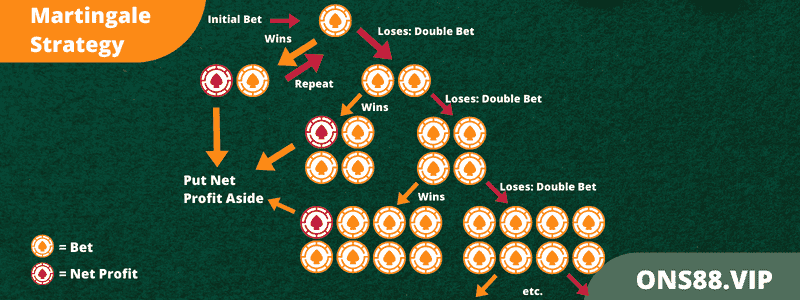
The Martingale is the most famous roulette system and one of the oldest, dating back to 18th-century France. The rule is simple: place an even-money bet (red/black, odd/even, high/low). If you win, pocket the profit and bet the same amount again. If you lose, double your bet on the next spin. Keep doubling after every loss until you win, then reset to your original stake.
Example Bet Sequence
Suppose your base bet is RM5. You lose four spins in a row, then win on the fifth:
RM5 (L) > RM10 (L) > RM20 (L) > RM40 (L) > RM80 (W)
Total wagered: RM155. Total returned: RM160 (RM80 bet + RM80 win). Net profit: RM5 -- exactly one base unit. That single-unit profit after any length of losing streak is the core appeal of the Martingale.
Advantages
- Extremely easy to learn and remember.
- A single win recovers all previous losses.
- Works well during short sessions with brief losing streaks.
Disadvantages
- Requires a large bankroll -- bets escalate fast (RM5 becomes RM640 after just seven losses).
- Table maximum limits can block further doubling, leaving you unable to recover.
- Extended losing streaks, though unlikely on any single session, do happen and can be devastating.
Tips for Using the Martingale
Choose tables with a low minimum and a high maximum to give yourself the widest doubling range. Set a strict loss cap -- for example, "I will stop after six consecutive losses" -- and honour it. Start with a small base bet relative to your total bankroll; RM5 on a RM500 bankroll gives you room for about six doublings.
Reverse Martingale and Paroli System
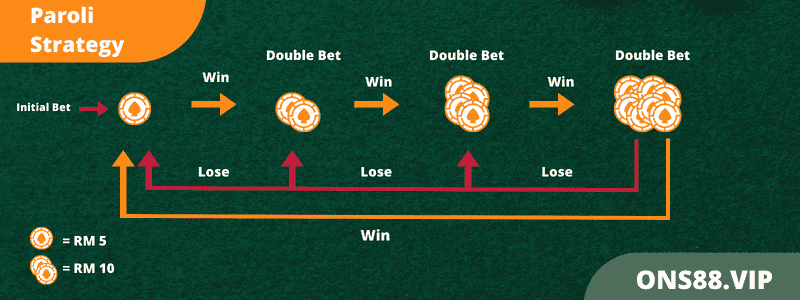
The Reverse Martingale flips the script: instead of doubling after a loss, you double after a win. When you lose, you return to your base stake. The idea is to ride winning streaks and let profits compound while keeping losses to one base unit per losing spin.
The Paroli system is closely related but adds a safety cap. You double your bet after each win, but only for three consecutive wins. After the third win, you collect your profit and reset. For example, with an RM4 base bet: RM4 (W) > RM8 (W) > RM16 (W) > collect RM28 profit, reset to RM4. If you lose at any point in the cycle, you simply go back to RM4.
The Paroli is popular among players who dislike the unlimited exposure of the standard Martingale. It puts a ceiling on how much you risk from any single winning streak turning sour. The downside is that three consecutive wins on an even-money bet happen only about 12.5% of the time, so patience is required.
The Fibonacci System
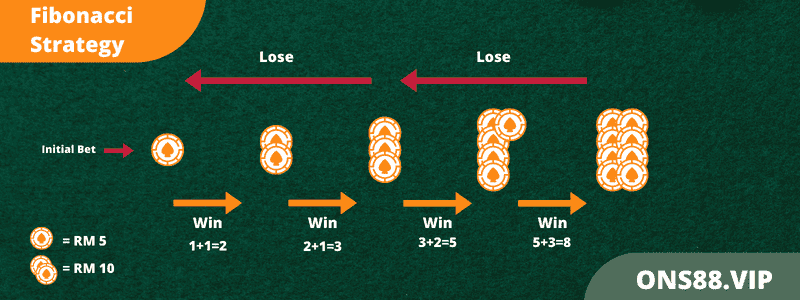
Named after the Italian mathematician Leonardo Fibonacci, this system uses the famous number sequence where each number is the sum of the two before it: 1, 1, 2, 3, 5, 8, 13, 21, 34, 55, 89, 144 and so on. In roulette, each number represents your bet in units.
How It Works
Start at the beginning of the sequence. If you lose, move one step forward and bet the next number. If you win, move two steps back. The goal is to return to the start of the sequence, at which point you will be in profit. Using RM1 units:
RM1 > RM1 > RM2 > RM3 > RM5 > RM8 > RM13 > RM21 > RM34 > RM55 > RM89 > RM144
Suppose you lose until you reach the RM8 step, then win. You move back two places to RM3. If you win again, you move back to RM1. Continue until you complete the sequence or reach your session limit.
Pros
- Bets increase more slowly than in the Martingale, so you need a smaller bankroll for the same number of losses.
- Easy to learn once you understand the sequence.
- Can generate consistent small profits during mixed win/loss sessions.
- Works on any even-money bet.
Cons
- A long losing streak still pushes bets high -- RM1 reaches RM144 after twelve losses.
- The "move back two steps" rule means a single win does not fully recover all losses, unlike the Martingale.
- Requires patience and careful tracking of where you are in the sequence.
Reverse Fibonacci
Some players prefer to reverse the system: advance through the sequence on wins and reset to the start on losses. This means you only scale up when you are winning, keeping losses to single base units. The trade-off is that you cannot earn big unless you hit a sustained winning run, but losing streaks are far less painful since each loss costs just RM1.
The D'Alembert Method
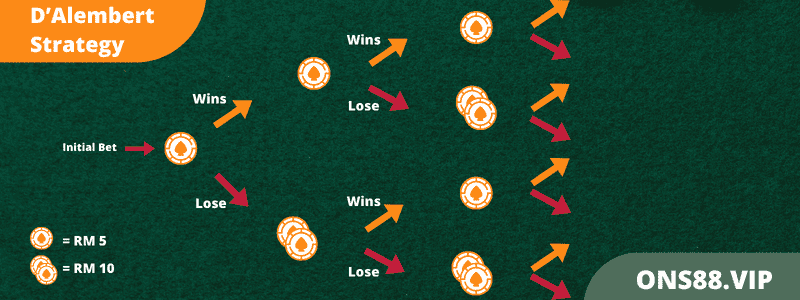
Named after French mathematician Jean le Rond d'Alembert, this is one of the safest progressive systems. The rule: increase your bet by one unit after a loss and decrease it by one unit after a win. If your base bet is RM10 and you lose, your next bet is RM11. Win, and the next bet drops to RM10. Lose again, it goes to RM11, and so on.
Strengths
- Bets rise and fall gently, avoiding the dramatic escalation of the Martingale.
- Easy to understand and track -- just add or subtract one unit.
- Good for beginners and players with modest bankrolls.
Weaknesses
- Relies on the assumption that wins and losses will roughly balance over time, which is not guaranteed in any single session.
- Prolonged losing streaks can still drain a bankroll, just more slowly.
- Profits accumulate slowly compared to more aggressive systems.
The D'Alembert works best on European roulette tables with even-money bets. Set clear win and loss limits, and choose tables whose minimum bet aligns with your unit size.
The Labouchere System
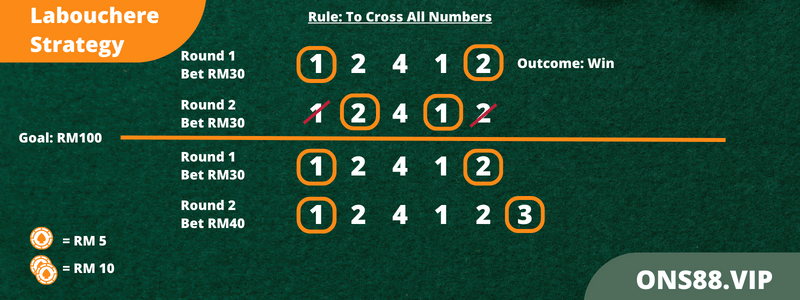
Also called the cancellation system, the Labouchere is a more sophisticated negative-progression approach. You begin by writing down a sequence of numbers that represents your desired profit. For example: 1 - 2 - 3 - 4. Your total target profit is the sum of these numbers (10 units).
How It Works
Each bet equals the sum of the first and last numbers in your sequence. In our example, that is 1 + 4 = 5 units. If you win, cross off those two numbers. Your next bet would be 2 + 3 = 5 units. Win again and all numbers are crossed off -- you have reached your RM10 target. If you lose, add the amount you just bet to the end of the sequence. So after losing a 5-unit bet, your sequence becomes 1 - 2 - 3 - 4 - 5, and your next bet is 1 + 5 = 6 units.
Pros and Cons
The Labouchere lets you customise your target profit and gives a structured roadmap to reach it. However, extended losing streaks can make the sequence grow long and bets grow large. Careful bankroll management and a willingness to abandon a sequence that gets out of hand are essential. Some players set a rule: if the sequence exceeds a certain length (say eight numbers), they stop and start fresh.
The Andrucci System
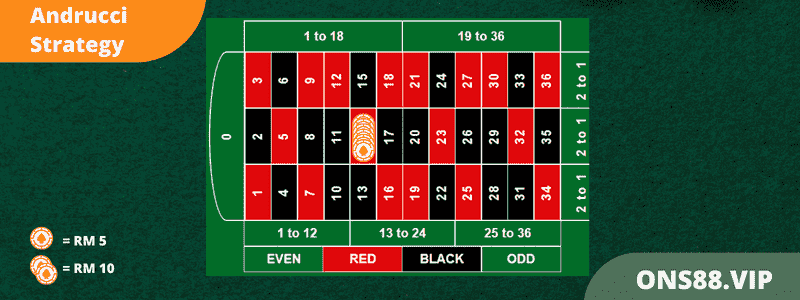
Unlike the systems above, the Andrucci is based on chaos theory rather than bet-sizing progression. The idea, attributed to Italian mathematician Giancarlo Andrucci, is that over a short sample of spins, certain numbers will appear more often than probability predicts. You observe 30 to 40 spins, identify the "hot" numbers that have come up most frequently, and then place straight-up bets on those numbers.
The appeal is the potential for a 35:1 payout if your chosen number hits. The risk is substantial: you are betting on single numbers with a low probability of success, and there is no mathematical guarantee that a number's past frequency will continue. The Andrucci is best treated as a high-risk, high-reward side strategy rather than a primary system. Use a small portion of your bankroll and set a strict spin limit for how long you will pursue a hot number before moving on.
Progressive vs Non-Progressive Betting
Understanding the distinction between these two categories will help you choose the right approach for your goals.
Progressive Betting
Progressive systems change your bet size based on the previous outcome. Negative-progression systems (Martingale, Fibonacci, D'Alembert, Labouchere) increase bets after losses. Positive-progression systems (Reverse Martingale, Paroli) increase bets after wins. The potential upside of progressive betting is faster loss recovery or compounding of winnings. The downside is increased exposure during losing streaks or the risk of giving back a winning run.
Non-Progressive (Flat) Betting
Flat betting means wagering the same amount on every spin regardless of whether you won or lost the last one. It is the most conservative approach: your risk per spin is constant, your bankroll depletes at a predictable rate, and you never face the shock of a suddenly huge bet. Many experienced players use flat betting on outside bets for long sessions where the goal is entertainment rather than chasing big wins.
The Andrucci system is also considered non-progressive because your bet size does not change based on outcomes -- it changes based on observed patterns instead.
How to Choose the Right Strategy
There is no single "best" system. The right strategy depends on several personal factors:
- Risk Tolerance: Aggressive players who can stomach big swings may gravitate toward the Martingale or Labouchere. Conservative players who prefer steady sessions should consider the D'Alembert or flat betting.
- Bankroll Size: The Martingale requires a large bankroll relative to your base bet. The Fibonacci and D'Alembert need less. If your bankroll is modest, start with a low base unit and a gentle progression.
- Table Limits: Every roulette table has minimum and maximum bet limits. Make sure your chosen system can operate within those boundaries. A Martingale player on a table with a RM500 maximum and a RM10 minimum can only double five times before hitting the cap.
- Playing Style: Some players enjoy the structure and ritual of tracking a Labouchere sequence. Others want the simplicity of "double or reset." Pick a system whose mechanics you find enjoyable, not just mathematically interesting.
Strategy Comparison at a Glance
Here is a quick summary to help you compare:
- Martingale -- Double after loss. Fast recovery. High bankroll requirement. Best for short sessions.
- Paroli -- Double after win (max 3 times). Low risk. Needs winning streaks. Best for cautious players.
- Fibonacci -- Follow sequence after loss, step back two on win. Moderate risk. Slower recovery. Good middle ground.
- D'Alembert -- Add one unit after loss, subtract one after win. Low risk. Slow profits. Great for beginners.
- Labouchere -- Custom sequence, cross off numbers on wins. Medium risk. Flexible targets. Needs tracking.
- Andrucci -- Bet on observed hot numbers. High risk. Potential big payouts. Not based on progression.
- Flat Betting -- Same bet every spin. Lowest risk. Predictable session length. Best for entertainment-focused play.
Whichever system you choose, remember these universal rules: always play European roulette, set firm win/loss limits, manage your bankroll carefully, and treat every session as entertainment. No strategy can overcome the house edge in the long run, but the right system can make your time at the wheel more structured, more disciplined, and more enjoyable.
Frequently Asked Questions
1. What is the best roulette strategy for beginners?
The D'Alembert system is a solid starting point. You increase your bet by one unit after a loss and decrease by one unit after a win. It is gentler on your bankroll than the Martingale and easy to follow. Pair it with even-money outside bets such as red/black for the safest introduction to strategic roulette play.
2. Do roulette strategies guarantee winning?
No. Roulette is a game of chance, and every spin is independent. No strategy can eliminate the house edge. What strategies can do is help you manage your bankroll, set disciplined win/loss limits, and make more informed betting decisions so you get more entertainment from your budget.
3. What is the difference between the Martingale and Fibonacci systems?
Both are negative-progression systems where you raise bets after a loss. The Martingale doubles your bet each time, so stakes climb very fast. The Fibonacci follows the sequence 1-1-2-3-5-8-13 and so on, meaning bets rise more slowly. The Fibonacci is considered less risky but takes longer to recover losses.
4. Should I play European or American roulette?
Always choose European roulette when available. It has a single zero pocket and a house edge of 2.70%, compared to American roulette's double zero and 5.26% house edge. That difference directly affects how far your bankroll stretches and how effective any strategy can be.
5. Can I use roulette strategies at online casinos in Malaysia?
Yes. Online roulette games use random number generators or live dealers, and the mechanics are identical to land-based tables. You can apply any strategy -- Martingale, Fibonacci, D'Alembert, Labouchere or Andrucci -- just as you would in a physical casino. Choose a reputable, licensed platform to ensure fair play.
6. How much bankroll do I need for the Martingale system?
A safe rule of thumb is to have at least 50 to 100 times your base bet. If your starting wager is RM5, you should have RM250 to RM500 set aside. Keep in mind that table maximum limits can also cap how many times you can double, so pick tables with low minimums and high maximums.